Kilimanjaro Summit Night
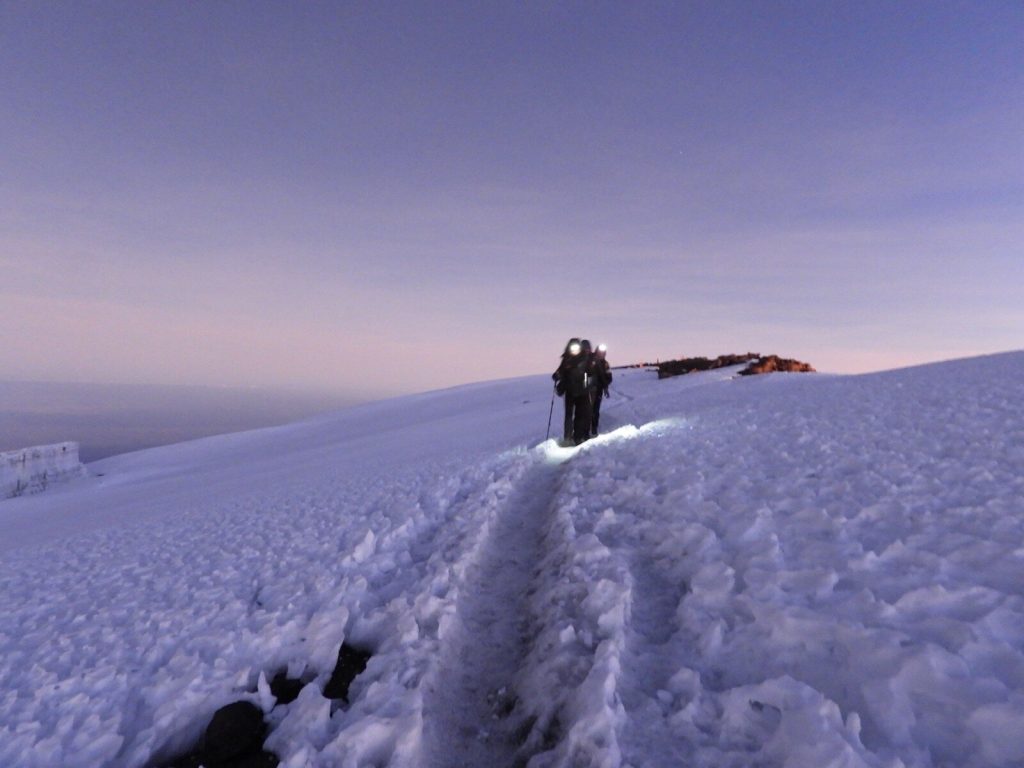
Summit night on Kilimanjaro begins around midnight from a high camp at 4,670 to 4,750 metres and takes five to seven hours of climbing on loose scree to reach the crater rim, then one to two hours along the rim to Uhuru Peak. Temperatures sit between roughly minus seven and minus twenty degrees Celsius. The full day, including the descent, runs twelve to fourteen hours. Kilimanjaro’s summit stands at 5,895 metres in northern Tanzania.
Why Summit Night on a Kilimanjaro Trek Starts at Midnight
Everyone asks this, usually while lying awake at the high camp. There are three reasons and they all hold up.
Time is the main one. The full round trip from the high camp to the summit and down to a lower camp takes twelve to fourteen hours of movement. Leaving at midnight means you finish in daylight rather than descending 2,800 metres in the dark.
Scree is the second. The steep slope above the high camps is loose volcanic gravel, and it is considerably more stable when frozen overnight than when the sun has softened it. Climbing frozen scree is unpleasant; climbing thawed scree is worse.
Then sunrise, which is the reason the marketing gives and the least important of the three. Reaching the crater rim as the sky lightens over Mawenzi and the plains is genuinely one of the better sights available anywhere, but the schedule would look much the same without it.
A handful of operators run daytime summit variants on longer itineraries, reaching the rim in daylight instead. Some climbers find that considerably easier mentally, at the cost of the sunrise.
Nobody sleeps well at the high camp. Thin air, cold and anticipation combine against it, and you will probably lie there for four hours getting little rest. Guides will tell you that lying still in a warm bag counts for something, and they are right. Do not treat a sleepless evening as a bad omen; it is the normal experience.
The Afternoon Before Your Kilimanjaro Summit Climb
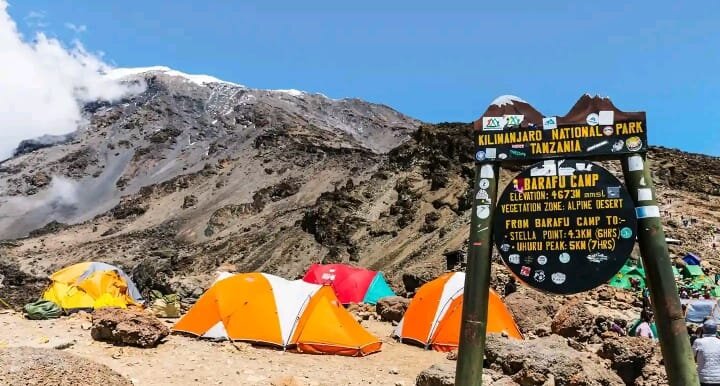
You arrive at Barafu, Kibo Hut or School Hut around midday or early afternoon, deliberately early. What happens next matters more than most trekkers realise.
Eat, even without appetite, because appetite has almost certainly gone by now and you need the carbohydrate. Drink steadily. Your guide runs a health check with the pulse oximeter and a symptom score, and this is where a summit attempt gets confirmed or called off. A rising altitude sickness score at this point is the usual reason for the answer being no.
Then a gear check, which good guides do properly. Every layer laid out, headlamp tested, spare batteries located, water bottles filled and insulated, snacks moved into accessible pockets rather than the bottom of the pack. Anything you cannot find in the dark at midnight might as well not be with you.
Dinner is early, often around five or six. Then bed while it is still light, with your summit clothing either on or immediately to hand and your boots inside the tent so they do not freeze solid overnight. Boots that fit and have been worn in matter more tonight than on any other night of the trek.
What to Wear on Kilimanjaro Summit Night
This is the coldest part of the whole trek and the layering needs to be right before you leave the tent, since adjusting a base layer at minus fifteen in a wind is not realistic.
Upper body: a wicking base layer, a thermal or fleece mid layer, an insulated jacket, a heavy down jacket and a waterproof windproof shell over the lot. Four or five layers is normal here, which is the top end of the layering system you have been using all week.
Legs: thermal leggings, insulated or fleece trousers, and waterproof overtrousers as a wind barrier. Head and hands: a warm hat plus a balaclava or buff covering your face, thin liner gloves under thick insulated gloves or mittens, so you can open a zip without exposing bare skin. Feet: two pairs of dry socks and gaiters over the boots for the scree.
Water bottles rather than a bladder, because hose tubes freeze solid. Fill them with warm water at camp, carry them insulated, and store them upside down so the ice forms away from the lid. Keep spare headlamp batteries in an inside pocket where your body heat slows the drain.
Hour by Hour Through a Kilimanjaro Summit Trek
You are woken around eleven at night. Hot tea and a biscuit in the mess tent, a final check, and out into the dark at midnight.
The first hour is switchbacks on loose scree, and the pace immediately feels absurd. It is meant to. Your guide will keep it slower than anything you would choose, and this is the hour where fit climbers make their mistake by pushing ahead.
By hours two and three you have settled into it. A line of headlamps stretches above and below you on the busier routes, which some people find motivating and others find dispiriting. Rest stops come roughly every hour for five or ten minutes, and those stops are when you get cold, so the down jacket goes on and you keep moving gently.
Hours four and five are the hard part. Cold has worked into everything, the altitude is at its most obvious, and there is no visible progress because you cannot see the rim. This is where people turn back, and it is almost always a decision rather than a physical failure. It is the hour in which the difficulty of Kilimanjaro stops being physical.
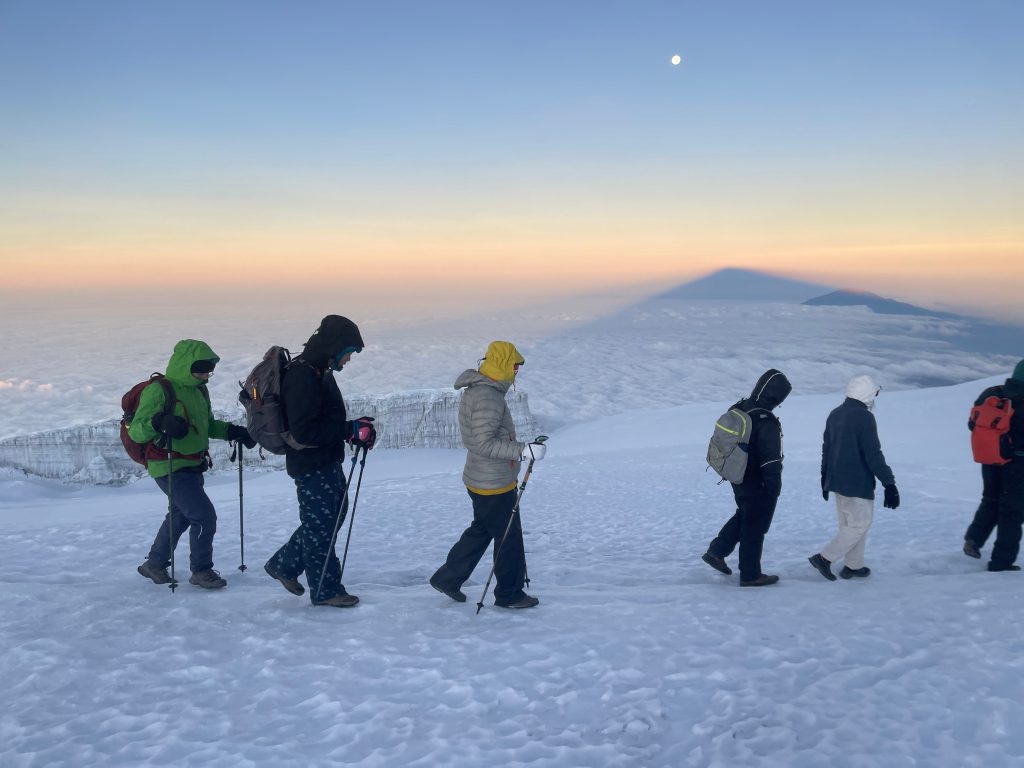
Around hour five or six the sky starts to lighten behind Mawenzi, and the rim comes into view. Trekkers arriving from the west reach Stella Point at roughly 5,750 metres; those from the east reach Gilman’s Point at about 5,685. Both sit on the crater rim, a little under the mountain’s full height.
Reaching the Crater Rim on a Kilimanjaro Summit Climb
Getting to the rim is the emotional moment on this mountain, more so than the summit sign for many people. The steep work is finished, the sun is coming up, and the glaciers appear.
From Stella Point it is roughly an hour of gentler walking along the crater edge to the summit itself at Uhuru Peak. From Gilman’s Point it is one and a half to two hours, which is the longer of the two finishes and a real consideration for anyone on Marangu, Rongai or the Northern Circuit.
Both points earn a park certificate, and plenty of climbers stop at Gilman’s. That decision is usually made by an exhausted trekker at 5,685 metres calculating another two hours in the cold, and it is a legitimate one rather than a failure.
The rim walk itself is not steep. What makes it demanding is doing it at that altitude on no sleep after six hours of climbing, with the wind coming across the crater.
Ask anyone who has done it and the hardest hour was the one before dawn, when there was nothing to look at and no way to tell how much further there was to go.
Practical Advice for Getting Through Summit Night
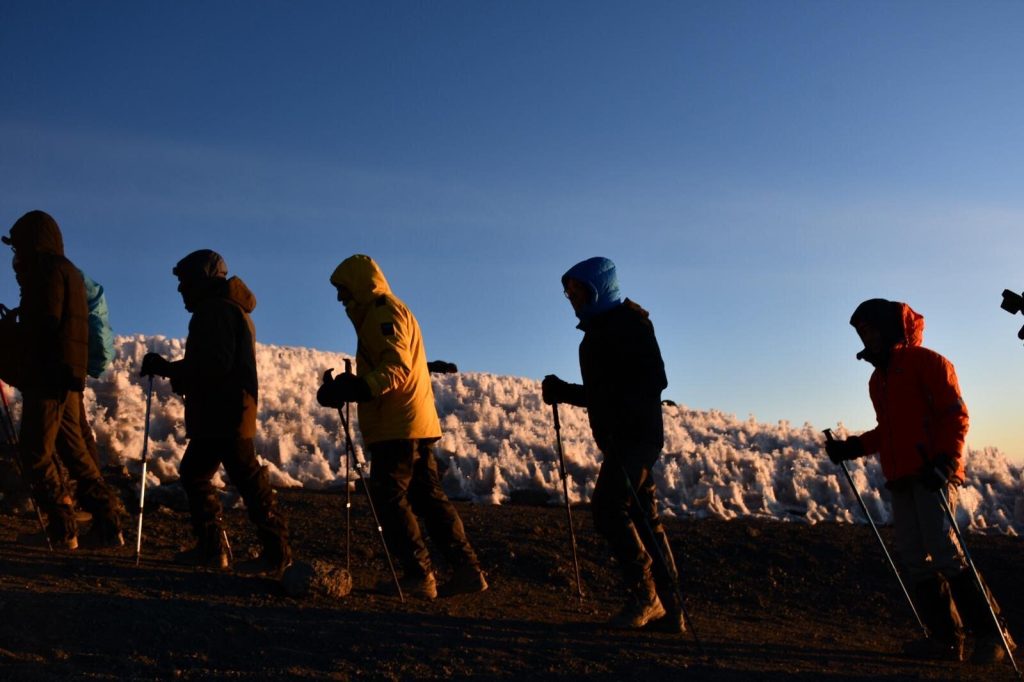
Small things carry disproportionate weight on this particular night.
Eat and drink at every stop, even in small amounts, and even though neither appeals. Cold and altitude both suppress the urge and you need the fuel for another eight hours.
Keep your headlamp aimed at the boots in front of you rather than up the slope. Looking up at a line of lights disappearing into the sky is discouraging and looking at your feet is enough to walk by.
Break the night into segments rather than thinking about the summit. The next rest stop is a manageable target; Uhuru Peak at hour one is not. Guides do this instinctively and it is worth doing for yourself.
Tell your guide how you are. Concealing a bad headache to protect your chances is the classic error and it usually ends the attempt anyway, later and less safely.
Take a photograph at the rim as well as the summit. Some people are too spent to appreciate the top at the time and are glad of the pictures afterwards.
Summit Night on Each Kilimanjaro Trekking Route
Machame, Lemosho, Shira and Umbwe. Leave Barafu at roughly 4,670 metres, arrive at Stella Point, then about an hour to the summit. The shorter rim walk.
Marangu and Rongai. Leave Kibo Hut at about 4,700 metres, arrive at Gilman’s Point, then one and a half to two hours to the summit. The harder finish.
Northern Circuit. Leaves School Hut at roughly 4,750 metres and also arrives at Gilman’s Point, with the longest total summit day of any route at up to sixteen hours.
Crowds. Barafu is the busiest high camp, and in July and August groups depart at staggered times through the night. School Hut is noticeably quieter.
Descent after the summit. Most routes drop to Mweka or Millennium Camp near 3,100 metres. Marangu and Rongai descend to Horombo at 3,720 metres instead.
Full moon departures. Available on any route. Note that the Kibo massif blocks the setting moon after around three in the morning, so bring the headlamp regardless.
The Descent After Your Kilimanjaro Summit Climb
Half the day is still ahead of you when you leave the summit, and this is the part people forget to prepare for.
You drop back down the scree to the high camp, which is fast and jarring on the knees and takes two to three hours. There you get a rest and hot food, usually an hour or so, and almost everyone would rather sleep than eat.
Then you continue down to a lower camp the same afternoon, dropping to around 3,100 metres on most routes. The relief of thicker air is immediate and genuinely noticeable, and it is the reason guides push you to keep going rather than stopping at the high camp.
Trekking poles matter more here than anywhere on the mountain, and a knee support is worth wearing as a precaution. Total time on the move from midnight commonly reaches twelve to fourteen hours, and up to sixteen on the Northern Circuit. It is the longest day of the week by a wide margin.
Frequently Asked Questions About Kilimanjaro Summit Night
How long does summit night take?
Five to seven hours from the high camp to the crater rim, then one hour to Uhuru Peak from Stella Point or one and a half to two hours from Gilman’s Point. The descent to the high camp takes two to three hours and the onward walk to a lower camp several more. Total movement from midnight is twelve to fourteen hours, and up to sixteen on the Northern Circuit.
How cold is summit night on Kilimanjaro?
Between roughly minus seven and minus twenty degrees Celsius before dawn, with wind chill making it feel colder, and readings as low as minus twenty seven recorded at the summit. Water freezes in bottles, hydration hoses freeze solid and battery life drops sharply. Those figures apply year round, since seasonal variation at the summit is small.
Do I need extra gear for summit night, and what does it cost?
A heavy down jacket and insulated trousers are the two additions beyond ordinary trekking layers, and both can be rented in Moshi for roughly $30 to $50 each rather than bought for $150 to $400. Hand and toe warmers cost a few dollars a pair and are worth carrying. Everything else, the balaclava, liner gloves and gaiters, should be part of your standard kit.
What if I cannot make it to the summit?
An assistant guide takes you back down to the high camp while the rest of the group continues, which is why guide ratios matter when choosing an operator. Reaching Gilman’s Point or Stella Point still earns a park certificate. Turning back on summit night is common and it is not treated as a failure by any decent crew.
Can I sleep before summit night?
You can lie down and most people get very little actual sleep. Thin air disrupts breathing patterns, the high camps are cold and windy, and other groups are moving around. Go to bed early anyway, rest with your eyes closed, and avoid sleeping tablets, which suppress breathing at altitude and are genuinely dangerous at 4,700 metres.
Is summit night dangerous?
It carries the highest risk of the trek, and the risks are altitude illness, cold injury and exhaustion rather than falling. There is no technical ground and no exposure. Good operators carry bottled oxygen, check you before you leave the high camp, and turn people around when the readings say so. Insurance covering trekking above 5,000 metres and helicopter evacuation is necessary rather than optional.
Booking Your Kilimanjaro Trip
The safari companies and tour operators listed on this website put trips like this together for a living and know which camps, guides and routes actually deliver. We are an independent guide to Kilimanjaro; we do not book or sell tours ourselves.
When you are ready, arrange your safari, tour or holiday with one of the recognised operators listed here. Tell them your dates and what matters most, and a real person, not a form, will handle the itinerary, park bookings and logistics for you.