Rongai Route

The Rongai Route is a six or seven day camping trek up Mount Kilimanjaro and the only trail that climbs the mountain from the north, starting near the Kenyan border at Nale Moru and covering roughly 70 to 74 kilometres. Seven day itineraries report summit rates around 85 percent, six day versions nearer 70. Rongai sits on the driest side of Kilimanjaro National Park in northern Tanzania and descends via Marangu.
Rongai Route Trekking on the Northern Side
Rongai route trekking is the quiet option for people who want camping rather than huts but would rather not queue behind three hundred other climbers at the Barranco Wall. Roughly one climber in twenty picks it, and for the first four days you will see almost nobody outside your own group. Only the little used Shira trail and Umbwe see fewer boots than this.
Two things define this trail. The first is dryness. The northern flank sits in the mountain’s rain shadow, so while the southern forest is dripping, Rongai is often walking under clear sky. That makes it the trail of choice in the shoulder weeks when everything else is muddy.
The second is the altitude profile, and here the news is mixed. Rongai climbs steadily and gently with far fewer chances to gain height during the day and then drop back down to sleep. That pattern is the engine behind the southern Machame trail and its western neighbours, and Rongai largely lacks it. The gradient underfoot is the easiest on the mountain after Marangu; the acclimatisation is not.
Because the profile does less of the work for you, the extra day matters more on Rongai than almost anywhere. The seventh day goes into an acclimatisation stop at Mawenzi Tarn, and it is the single reason to pay more here. A six day Rongai is a harder week than the elevation chart suggests.
Rongai Trek Day One from Nale Moru to Simba Camp
The first morning is mostly driving, and it is a long one. You register at Marangu Gate on the eastern side, then travel roughly 70 kilometres on rough roads around the northern flank to the Rongai trailhead near Nale Moru village at about 1,950 metres. Two and a half hours in a Land Cruiser is normal.
Walking starts through maize fields and potato plots, then pine and natural forest on a winding path that never gets steep. Three to four hours and about six kilometres brings you to Simba Camp at roughly 2,600 metres, at the edge of the moorland.
This is the best wildlife day on the mountain. Black and white colobus are commonly seen in the forest, and elephant and buffalo do move through the lower northern slopes, though seeing them is a matter of luck rather than expectation. Views open north over the Kenyan plains from camp.
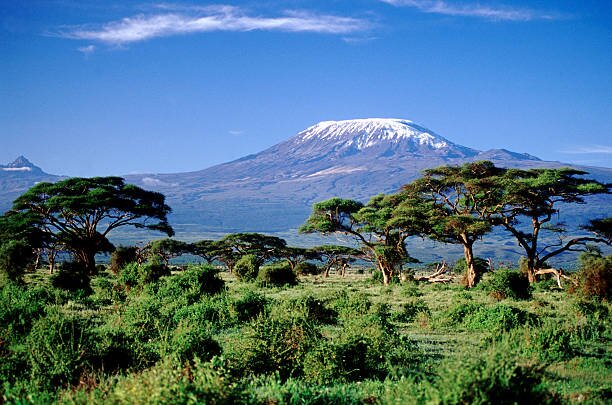
Rongai Route Trekking to Kikelewa Camp
Day two crosses into the moorland proper. A steady incline brings you up to Second Cave at around 3,450 metres, usually the lunch stop, with the eastern ice fields on Kibo’s crater rim visible ahead for much of the morning.
After lunch the trail leaves the main path and turns towards Mawenzi on a smaller track, arriving at Kikelewa Camp at roughly 3,600 metres after five or six hours and about eight kilometres. Camp sits in a sheltered valley with giant senecio nearby and a stream below the caves, which you may have to walk a little way down to find.
Some eight day versions break this day in two with a night at Second Cave. On the standard six and seven day itineraries you cover it in one go, gaining nearly 1,000 metres, which makes it the biggest single day of climbing before the summit push.
Rongai Trekking to Mawenzi Tarn Camp
Short and steep. Six kilometres in three to four hours up grassy slopes, gaining around 700 metres to Mawenzi Tarn at roughly 4,320 metres. The heath gives out on the way and you step into alpine desert, where the ground turns to rock and scree and the vegetation stops entirely.
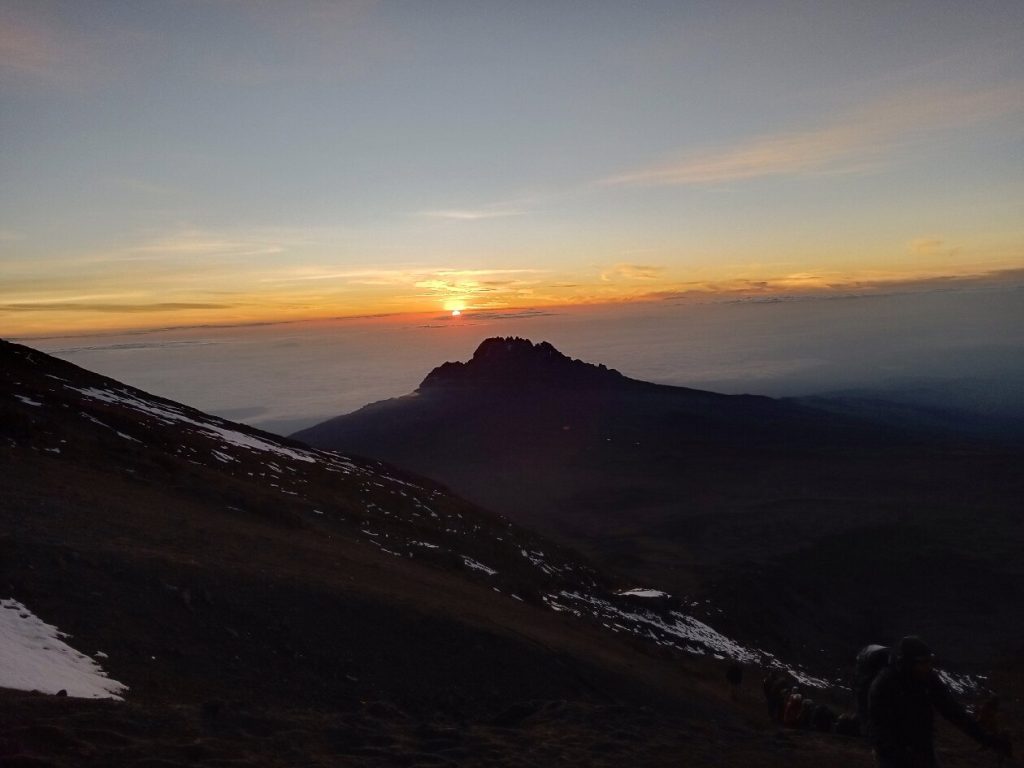
Mawenzi Tarn is the best campsite on this side of Kilimanjaro and arguably one of the best anywhere on the mountain. A small alpine lake sits directly beneath the shattered spires of Mawenzi, Kilimanjaro’s second cone at 5,149 metres, which looks far more like a mountaineer’s peak than Kibo does.
Afternoons here go on rest and a short walk uphill to touch around 4,500 metres before coming back down to sleep. On the seven day itinerary you stay a second night and spend the middle day walking the Mawenzi Ridge, gaining a few hundred metres and returning to camp. That day is the whole argument for the longer itinerary.
Rongai Route Trekking Across the Saddle to Kibo Hut
Leaving Mawenzi Tarn you cross the saddle, a broad stony desert between the two cones that looks flat on a map and takes far longer to walk than anyone expects. Nine or ten kilometres, four to six hours, climbing a modest 400 metres to Kibo Hut at roughly 4,700 metres.
There is nothing living up here. Wind comes across the saddle unobstructed and the light is flat and hard. Kibo Hut is where Rongai meets the Marangu trail, and for the first time in five days you will find yourself among other groups.
You arrive in the early afternoon, eat, sort your summit layers with your guide, and try to sleep from around six in the evening. Water freezes overnight at this camp, so bottles go into your sleeping bag and hydration hoses stay at home.
Rongai Route Summit Climb via Gilman’s Point to Uhuru Peak
Wake up around midnight. From Kibo the trail switchbacks up steep loose scree in the dark, and this section defeats more Kilimanjaro climbers than any other stretch on the mountain. It is relentless and the pace has to be slow enough to feel almost absurd.
Five or six hours brings you to Gilman’s Point on the crater rim at about 5,685 metres, generally around dawn with the sun coming up behind Mawenzi and the plains laid out below. From there it is another one and a half to two hours along the rim to Uhuru Peak at 5,895 metres, past the eastern glaciers.
Temperatures on the way up sit between roughly minus seven and minus twenty degrees Celsius before sunrise, colder in wind. Ascent runs five to eight hours, the descent to Horombo another five or six, and the day commonly totals ten to sixteen hours of movement. Poles and knee support come into their own on the scree.
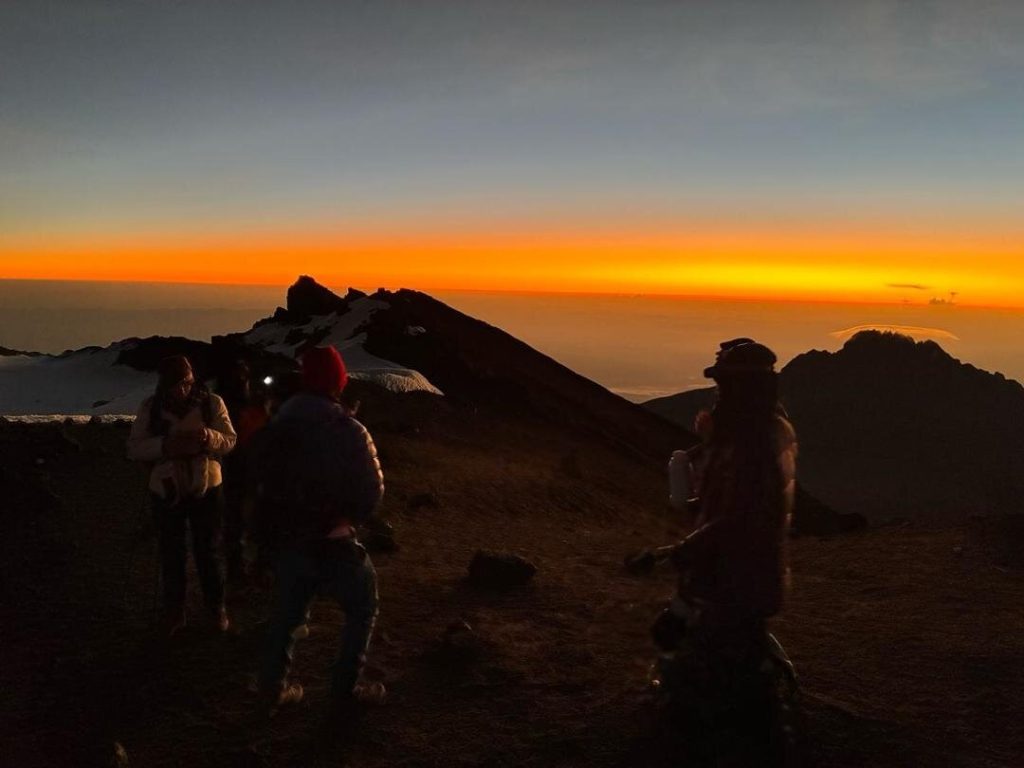
Rongai gives you the emptiest four days on Kilimanjaro and then delivers you to the busiest high camp on the mountain for a summit night that is the longest of any route. Both halves are worth knowing about in advance.
Rongai Trek Descent via Marangu to the Gate
Rongai does not come down its own side. From the summit you drop to Kibo, rest and eat, then continue down the Marangu trail to Horombo Hut at 3,720 metres for the night. Because Marangu is the hut route, this last night is spent in a bunk rather than a tent, which after summit day most people consider a bonus.
The final morning is a long walk of roughly 20 kilometres in five to seven hours down through moorland and forest to Marangu Gate, with a stop at Mandara for lunch. You sign out, collect your certificate and transfer to Moshi. Starting on one side of the mountain and finishing on the other is part of the appeal.
Six Day or Seven Day Rongai Trekking
Six days. Merges the Second Cave and Kikelewa stages or skips the second night at Mawenzi Tarn. Summit rates commonly quoted near 70 percent. Suited to walkers with prior time above 4,000 metres.
Seven days. Adds the acclimatisation day at Mawenzi Tarn with a walk on the Mawenzi Ridge. Summit rates around 85 percent. This is the version worth booking.
Eight days. Available privately. Splits day two with a night at Second Cave as well as keeping the Mawenzi Tarn rest day, which closes most of the gap to the western routes.
Framed plainly: on a route with a strong climb high and sleep low profile, a shorter itinerary is a calculated risk. On Rongai, where that profile is weaker, it is a bigger one. If your dates only allow six days on the mountain, a seven day Machame will serve you better than a six day Rongai. If you can stretch to eight days instead, the Lemosho crossing of the Shira Plateau gives your body considerably more help than any northern itinerary.
Best Time for a Rongai Route Trek
Rongai’s dryness is the reason it exists on many operators’ calendars year round. January to early March works well, with warm days, clear mornings and snow likely on the crater rim. Late June to October is the reliable long dry season, and even in July and August the trail stays quiet because the crowds are on the southern side.
Where this route genuinely separates itself is the shoulder weeks. April, May and November bring rain that turns the southern forest to mud, and the northern flank takes far less of it. Guides regularly recommend Rongai to anyone whose dates fall in those months, on the basis that a drier trail beats a marginally better acclimatisation profile that you spend soaking wet.
Getting to the Rongai Trailhead
Fly into Kilimanjaro International Airport between Moshi and Arusha, roughly an hour from Moshi by road. Moshi is the base for this trek, since registration happens at Marangu Gate on the eastern side before the long transfer around the mountain.
Budget most of day one for travel. Marangu Gate is around an hour from Moshi, then the drive to Nale Moru adds another two and a half hours on poor roads. It is the longest trailhead transfer on Kilimanjaro. Plan a night in Moshi before your briefing and another after you come down at Marangu Gate, and rent bulky gear in town rather than flying with it.
Frequently Asked Questions About the Rongai Route
How much does a Rongai route trek cost?
A seven day Rongai with a solid mid range operator generally runs $2,300 to $3,200 per person, with six day versions a few hundred dollars less and private premium climbs above $4,000. The long vehicle transfer to the trailhead adds a little to operating costs compared with Machame or Marangu. Flights, the visa at around $50, high altitude insurance, tips and personal gear are extra on almost every package.
What park fees apply on Rongai?
The same as every camping route. Conservation fees of roughly $70 per person per day, camping fees near $50 per person per night, a one off rescue fee about $20, and small park entry charges for each guide, porter and cook. Most published tariffs exclude the 18 percent VAT. Because the final night is spent at Horombo on the Marangu trail, that night is charged at the hut rate of around $60 instead of the camping rate. Your operator pays all of it directly.
Is Rongai easier than Machame?
Easier underfoot, harder on the altitude. The gradient is gentle, there is no Barranco Wall and the daily distances are moderate, which is why Rongai is often called one of the easiest trails on the mountain. But it offers fewer opportunities to climb high and sleep lower, so your body gets less help. A seven day Machame generally reports better outcomes than a six day Rongai.
How much should I tip on a Rongai trek?
Around $250 to $350 per climber for a six or seven day trek, scaled to crew size. Pooled across the group rather than paid individually, the usual daily guidance is $20 to $25 for the lead guide, $10 to $15 for assistant guides and the cook, and $5 to $10 per porter. A pair of climbers on seven days typically has a crew of about ten. Bring clean US dollar notes from home.
Will I see wildlife on the Rongai route?
The first day through the farmland and forest near Nale Moru is the best chance on the mountain. Colobus monkeys are commonly seen, and elephant and buffalo do use these lower northern slopes, though encounters are infrequent and never promised. Above the moorland the living world thins out to a few birds, then to lichen, then to nothing.
Where does the Rongai route finish?
At Marangu Gate on the south eastern side, not where you started. After the summit you descend the Marangu trail via Kibo and Horombo, spending the last night in a hut rather than a tent, then walk out roughly 20 kilometres to the gate. Crossing the mountain rather than retracing your steps is one of the quieter pleasures of this route.
Booking Your Kilimanjaro Trip
The safari companies and tour operators listed on this website put trips like this together for a living and know which camps, guides and routes actually deliver. We are an independent guide to Kilimanjaro; we do not book or sell tours ourselves.
When you are ready, arrange your safari, tour or holiday with one of the recognised operators listed here. Tell them your dates and what matters most, and a real person, not a form, will handle the itinerary, park bookings and logistics for you.