Northern Circuit Route
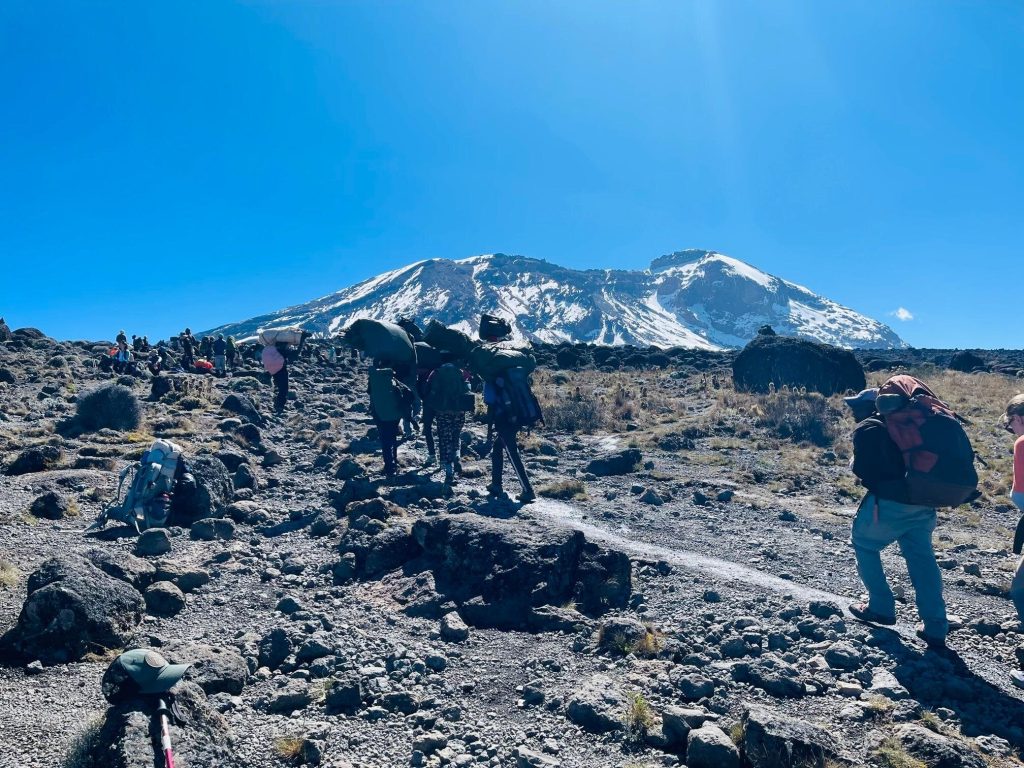
The Northern Circuit Route is a nine day camping trek up Mount Kilimanjaro that loops almost the whole way around the mountain, starting at Londorossi Gate in the west and summiting from the east at School Hut. Roughly 90 to 95 percent of climbers on this itinerary reach Uhuru Peak, the strongest record on the mountain. It is the longest trail in Kilimanjaro National Park in northern Tanzania and by far the quietest.
Northern Circuit Trekking and Why It Was Built
Northern Circuit trekking is the newest addition to Kilimanjaro’s trail network, and it exists to solve one problem: nobody had built a route long enough to give ordinary walkers a proper chance at 5,895 metres. Every other trail was designed around the shortest workable schedule. This one was designed around the human body.
The trek shares its first two or three days with Lemosho, walking in through western forest and crossing the Shira Plateau. Where Lemosho then turns south towards Barranco, the Northern Circuit heads north from Moir Hut and works clockwise around slopes that almost nobody else walks, through Buffalo Camp and Third Cave, before crossing the saddle to School Hut for the summit push.
You end up with close to 360 degrees of the mountain, nine nights of gradual height gain, and campsites where your group may be the only one. Operators sometimes call it the Grand Traverse or the 360 Route. Total walking distance runs to roughly 90 kilometres, more than any other trail.
This route is not chosen for the walking. It is chosen for the extra nights. If your leave is tight, an eight day Lemosho gets you most of the same benefit for less money. If you have the fortnight and only one shot at this mountain, the Northern Circuit is the honest recommendation.
Northern Circuit Trek Days One and Two Through the Western Forest
Londorossi Gate sits on the far western flank at about 2,250 metres, two to four hours from Moshi depending on traffic and the state of the forest track. Park formalities take a while here, then a vehicle carries you further towards the trailhead before you start walking.
Day one is three to four hours of gentle forest to Mti Mkubwa, sometimes called Forest Camp, at around 2,800 metres. Elephant and buffalo do use these lower slopes and their sign turns up on the path, which is why a ranger occasionally walks with groups here. Actual sightings are uncommon.
Day two climbs out of the trees through heather and tall grass to the Shira Ridge, then drops gently to Shira 1 Camp at roughly 3,500 metres. Cresting that ridge is where the trek changes character. The plateau opens out ahead, 13 kilometres of high open ground, with Kibo standing across it.
Northern Circuit Trekking Across the Shira Plateau to Moir Hut
Day three crosses the plateau eastwards past the Shira Cathedral, a rock buttress at about 3,880 metres, to Shira 2. Some itineraries stop there and some push on to Moir Hut the same day. Either way you end up at Moir Hut at roughly 4,200 metres, tucked into a valley at the foot of the Lent Hills.
Distances here are moderate, eight to fourteen kilometres over four to seven hours, and the gradient is kind. What matters is the altitude your body is now living at. Moir is a camp almost nobody visits on the standard routes, and guides usually take groups an hour or two up the Lent Hills in the afternoon to touch around 4,400 metres before coming back down to sleep.
That is the last camp shared with any other trail. From here you turn north and the mountain empties out.
Northern Circuit Trekking to Buffalo Camp and Third Cave
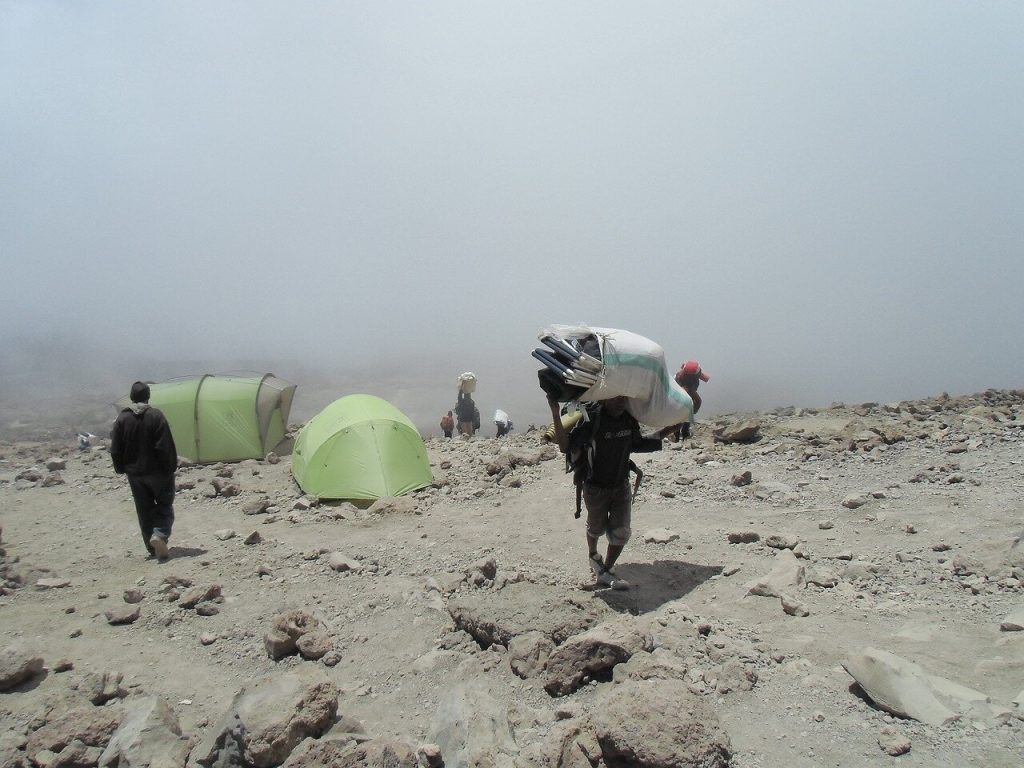
The walk out of the Moir Valley starts with a moderately steep climb, then a detour to the top of the Lent Hills at around 4,700 metres before rejoining the main path. From there the trail crosses a rock field and undulates east to Buffalo Camp, also called Pofu, at roughly 4,020 metres. Twelve kilometres, five to seven hours.
You end the day lower than you started it. That is the design, not an accident, and it is the mechanism behind this route’s record. Views run north across the plains towards the Kenyan border, and the wind up here has nothing to slow it down.
Day six heads up over the Buffalo Ridge and down through a series of small valleys with vegetation thinning to almost nothing, arriving at Third Cave Camp at around 3,800 metres. Seven or eight kilometres in four to five hours, and again slightly downhill on balance. Two consecutive days of no net height gain at over 3,800 metres is a luxury no other itinerary offers, and it is why people who felt rough on the plateau usually feel fine by now. It is also why this trail sits at the top of the reported summit tables.
Three days on the northern slopes, two of them ending lower than they began. Nothing about that sounds like progress towards a summit, and it is exactly why nine in ten climbers on this route get there.
Northern Circuit Trekking Over the Saddle to School Hut
Day seven is short and it earns its keep. A steady climb of about five kilometres in four to five hours brings you onto the saddle, the wide stony desert lying between Mawenzi’s spires and the bulk of Kibo. Nothing grows there and the scale is difficult to judge; the far side always looks closer than it is.
From the saddle you turn south west and up to School Hut at roughly 4,750 metres, arriving in the early afternoon. This is the high camp for northern and eastern climbers, quieter than Barafu on the southern side, though just as cold. Water freezes overnight, so bottles go into your sleeping bag.
Height gain today is nearly 1,000 metres, which is the biggest single day jump on the trek. Coming after six nights of careful acclimatisation, most people handle it without much trouble. The afternoon goes on eating, drinking, a gear check with your guide, and lying down from early evening.
Northern Circuit Route Summit Climb via Gilman’s Point
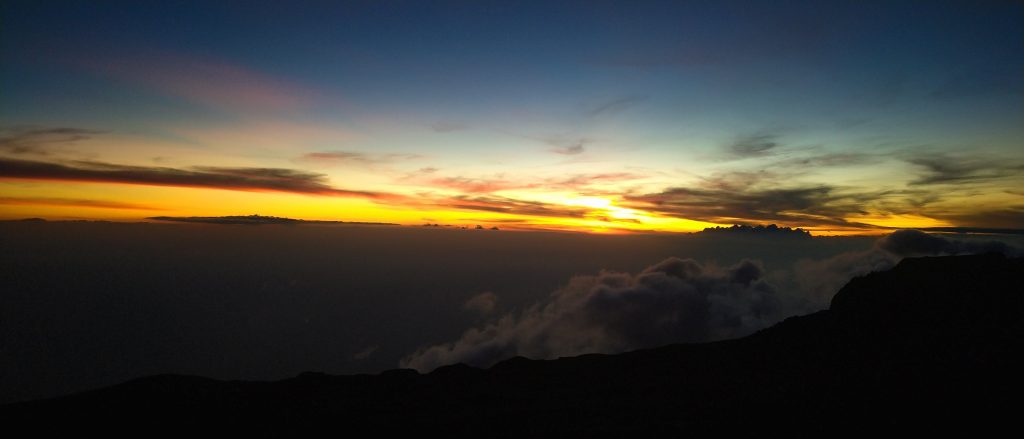
Wake up is around 11pm or midnight. From School Hut you climb switchbacks on loose volcanic scree in the dark, and this is where the Northern Circuit gets harder than the western routes rather than easier.
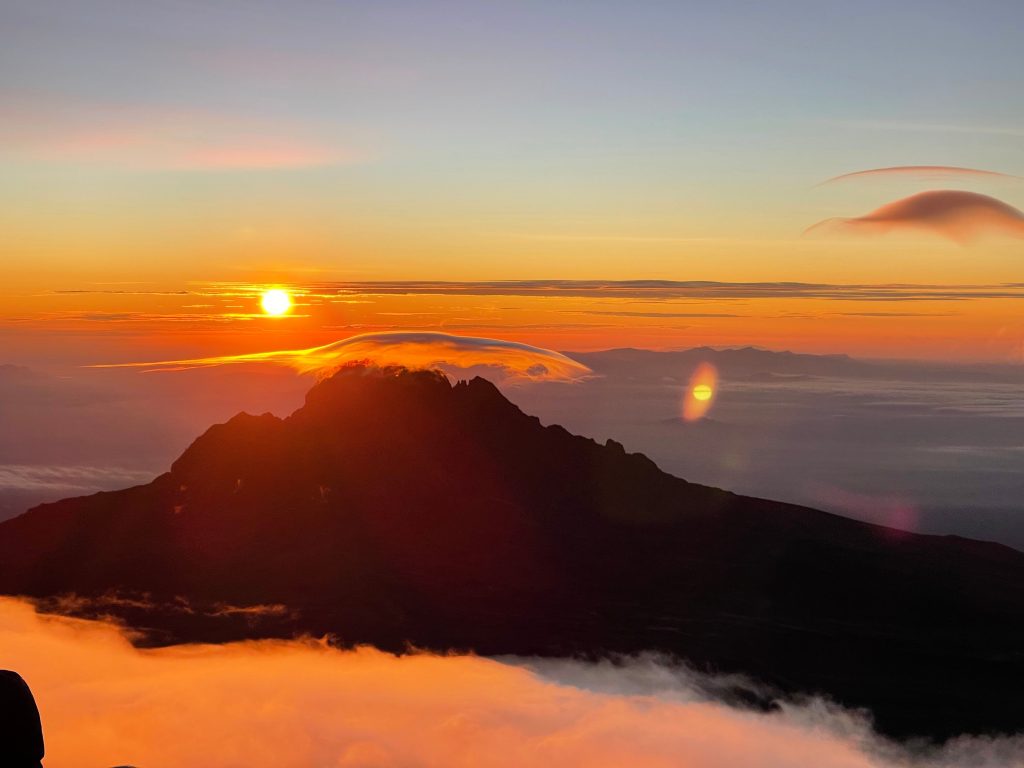
Eastern climbers reach the crater rim at Gilman’s Point at about 5,685 metres, usually as dawn breaks behind Mawenzi. From Gilman’s it is another one and a half to two hours around the rim to Uhuru Peak at 5,895 metres. Trekkers arriving at Stella Point on the southern trails face barely an hour of rim walking. That difference is real, and it is worth knowing before you book: this route buys you the best acclimatisation on the mountain and pays for it with the longest summit morning.
Temperatures before dawn sit between roughly minus seven and minus twenty degrees Celsius, colder with wind chill. Ascent takes six to eight hours, the descent to Mweka Camp another five to seven, and the whole day commonly runs eleven to sixteen hours on the move.
Northern Circuit Trek Descent to Mweka Gate
You come off the rim and drop down the western side of Kibo, past Barafu, and continue to Millennium or Mweka Camp at around 3,100 metres. It is a long descent on scree and then trail, and it is where knees and poles matter more than lungs.
The final morning is a three to four hour walk down through the forest to Mweka Gate, where you sign out and collect your certificate before the transfer to Moshi. Because you came up the far side of the mountain and go down this one, you finish having walked a near complete circle rather than a line.
Eight Day or Nine Day Northern Circuit Trekking
Nine days. The standard version and the one most operators sell. Includes the Lent Hills option, both northern slope days and a night at Third Cave. Summit rates commonly quoted at 90 to 95 percent.
Eight days. Compresses the plateau crossing, usually running Shira 1 through to Moir in one day. Still a strong itinerary, though it gives back part of the advantage you are paying for.
Ten days. Offered privately by some operators, occasionally with a night at Crater Camp near the summit. Extra park charges apply for sleeping in the crater.
The trade off is simple and it is not really about fitness. Nine days on the mountain means nine days of park charges, crew wages and food, which makes this the most expensive trail on Kilimanjaro. It also needs around a fortnight of leave once travel days are counted. Those two constraints, rather than any doubt about the route, are why so few climbers walk it. Most of them end up on a seven day Machame instead, which is the shortest itinerary with a genuinely solid record.
Best Time for a Northern Circuit Trek
January to early March gives warmer days, clear mornings and a decent chance of snow on the crater rim. Late June to October is the long dry season, colder at height but the most settled weather of the year. July and August fill the southern trails and Barafu; up on the northern slopes you will barely notice.
This route handles shoulder weeks better than the southern trails do, because the northern side of the mountain sits in a rain shadow and stays drier. April and May remain the long rains and the western forest days turn heavy, with the Londorossi track sometimes forcing an earlier start or a longer walk in. November into early December brings shorter rains that rarely stop anyone.
Getting to Londorossi Gate and Basing Yourself
Fly into Kilimanjaro International Airport, which sits between Moshi and Arusha, about an hour from Moshi by road. Moshi is the usual base and the town where almost every briefing happens. Londorossi is two to four hours from there, plus the forest track, so day one is a long morning in a vehicle before your boots touch the trail.
Book a night in Moshi before your briefing so a delayed bag does not become a crisis, and a night after you come down. Sleeping bags rated well below freezing, down jackets, poles and gaiters can all be rented in town, which is worth doing for a nine day itinerary where every kilogram in the duffel counts against the 15 kilogram limit.
Frequently Asked Questions About the Northern Circuit Route
How much does a Northern Circuit trek cost?
Nine day Northern Circuit packages generally run from about $2,800 to $3,800 per person with a good mid range operator, with premium private climbs going past $4,500 and budget group departures starting nearer $2,500. It is the dearest route on the mountain purely because of its length. Flights, the Tanzanian visa at around $50, high altitude insurance, tips and personal gear sit outside almost every quote.
Why is the Northern Circuit more expensive than other routes?
Because park charges are levied per day and per night regardless of trail. Conservation fees of roughly $70 per person per day across nine days come to around $630 before the 18 percent VAT that most published tariffs exclude, plus camping fees near $50 for each of the eight nights, a one off rescue fee about $20, and small entry charges for every crew member. Add nine days of wages and food for a crew of ten or more and the difference against a six day trek is several hundred dollars in fixed costs alone.
Is summit night harder on the Northern Circuit?
Yes, marginally. Climbers on this route reach the rim at Gilman’s Point and then face one and a half to two hours of walking around the crater edge to Uhuru Peak, against roughly an hour for trekkers arriving at Stella Point from the south. The compensation is that after eight nights of acclimatisation you arrive at School Hut in far better shape than most people arrive at Barafu on a six day itinerary.
How much should I tip on a nine day trek?
Budget roughly $350 to $450 per climber, since both the crew and the itinerary are larger than average. Daily figures pooled across the group rather than paid per climber run about $20 to $25 for the lead guide, $10 to $15 for assistant guides and the cook, and $5 to $10 for each porter. Longer routes carry more porters because more food goes up the mountain. Bring clean US dollar notes from home.
How quiet is the Northern Circuit really?
Genuinely quiet. Something close to one percent of Kilimanjaro climbers use it, and after Moir Hut you leave every other trail behind until the summit push. Buffalo Camp and Third Cave often hold one or two groups at most. Colobus monkeys are commonly seen in the western forest on day one, though wildlife higher up is limited to a handful of birds and nothing is guaranteed.
Do I need mountaineering experience for this route?
No. It is a walking trek throughout, with no rope work and no technical ground, and it does not go near the Barranco Wall or the Western Breach. What it asks is nine consecutive days of four to seven hours of walking on rough ground, so build up to long back to back days in the two or three months beforehand.
Booking Your Kilimanjaro Trip
The safari companies and tour operators listed on this website put trips like this together for a living and know which camps, guides and routes actually deliver. We are an independent guide to Kilimanjaro; we do not book or sell tours ourselves.
When you are ready, arrange your safari, tour or holiday with one of the recognised operators listed here. Tell them your dates and what matters most, and a real person, not a form, will handle the itinerary, park bookings and logistics for you.