Uhuru Peak Climb

Uhuru Peak is the summit of Mount Kilimanjaro at 5,895 metres, sitting on the rim of the Kibo crater and marked by a wooden sign. It is reached from Stella Point in about an hour or from Gilman’s Point in one and a half to two hours, and climbers usually stay only ten to twenty minutes. Uhuru is the highest point in Africa and the highest walkable summit on the continent, in northern Tanzania.
What Uhuru Peak Is and Where It Sits
Uhuru means freedom in Swahili, and the peak was named to mark Tanzanian independence. Before that it was called Kaiser Wilhelm Spitze, which tells you something about the century the mountain has had.
The geography is worth getting straight, because it confuses people planning an Uhuru Peak climb. Kilimanjaro is a massif with three volcanic cones, not a single peak. Kibo is the highest and youngest, Mawenzi at 5,149 metres is the shattered second cone, and Shira is the eroded oldest one, now a broad plateau the western routes cross.
Uhuru Peak is the highest point on the rim of Kibo’s crater. It is not the centre of the crater and it is not a separate summit; it is the high spot on a circular edge, which is why reaching the rim and reaching the summit are two different things and why the walk between them takes an hour or two.
Certificates are issued at the exit gate and there are two kinds. Reaching Stella Point or Gilman’s Point on the crater rim earns one; reaching Uhuru Peak earns the other. Both are genuine achievements and only one of them is the summit, which is worth knowing before you decide how you feel at 5,700 metres. How you feel up there is mostly a question of how well your body has adjusted over the preceding week.
The Three Ways to Reach Uhuru Peak on a Kilimanjaro Trek
Every trekking route converges on one of three passages onto the crater rim, and which one you use is determined by the trail you booked. All three are reached in the dark, on the long climb that begins around midnight.
Stella Point at roughly 5,750 metres is the western passage, used by Machame, Lemosho, Shira and Umbwe climbers coming up from Barafu Camp. From Stella it is about an hour of gentler walking along the rim to Uhuru Peak, which makes it the easiest finish.
Gilman’s Point at about 5,685 metres is the eastern passage, used by Marangu, Rongai and Northern Circuit climbers arriving from Kibo Hut or School Hut. From Gilman’s the rim walk runs one and a half to two hours, which is a meaningful difference after a sleepless night at altitude and explains part of why the eastern routes report lower summit figures.
The third passage is the Western Breach, a steep line past the Arrow Glacier reached from Umbwe or occasionally Machame, Shira or Lemosho. It is exposed to rockfall, has a history of fatalities, sometimes needs a helmet and basic climbing competence, and belongs to mountaineering rather than trekking. It is not part of a standard package.
The Final Rim Walk to Uhuru Peak
The rim walk is where the trek stops being a climb and becomes a matter of continuing to put one foot down.
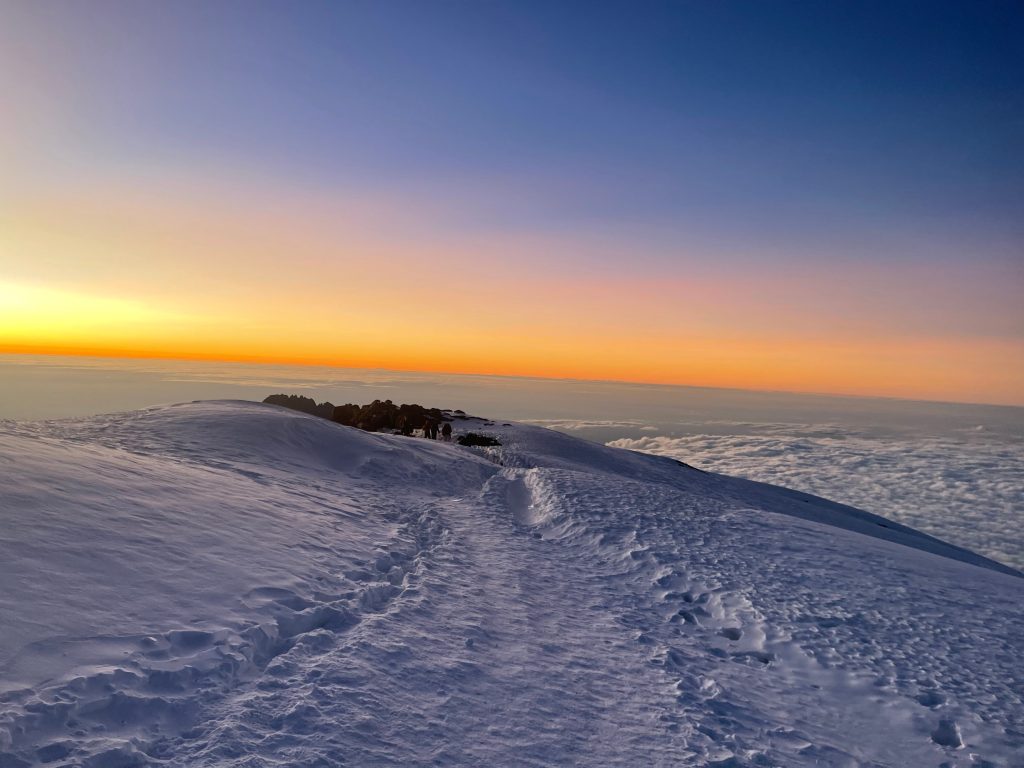
The gradient eases considerably once you are on the rim. What does not ease is the altitude, and you are now above 5,600 metres on roughly half the oxygen of sea level, having walked through the night. Guides slow the pace further here, and most people find they need to stop more often on the flattest ground of the whole ascent, which is a strange experience.
You walk the crater edge with the crater floor dropping away on one side and the plains of Tanzania and Kenya laid out on the other. The Rebmann and Ratzel glaciers appear on the southern section, and from parts of the rim you can see down into the Reusch Crater and the ash pit at the mountain’s centre.
The sun is usually up by now, which helps enormously with morale and only marginally with temperature. Then the sign appears, sometimes visible for a while before you reach it, which is its own particular form of encouragement.
Standing at the Uhuru Peak Summit
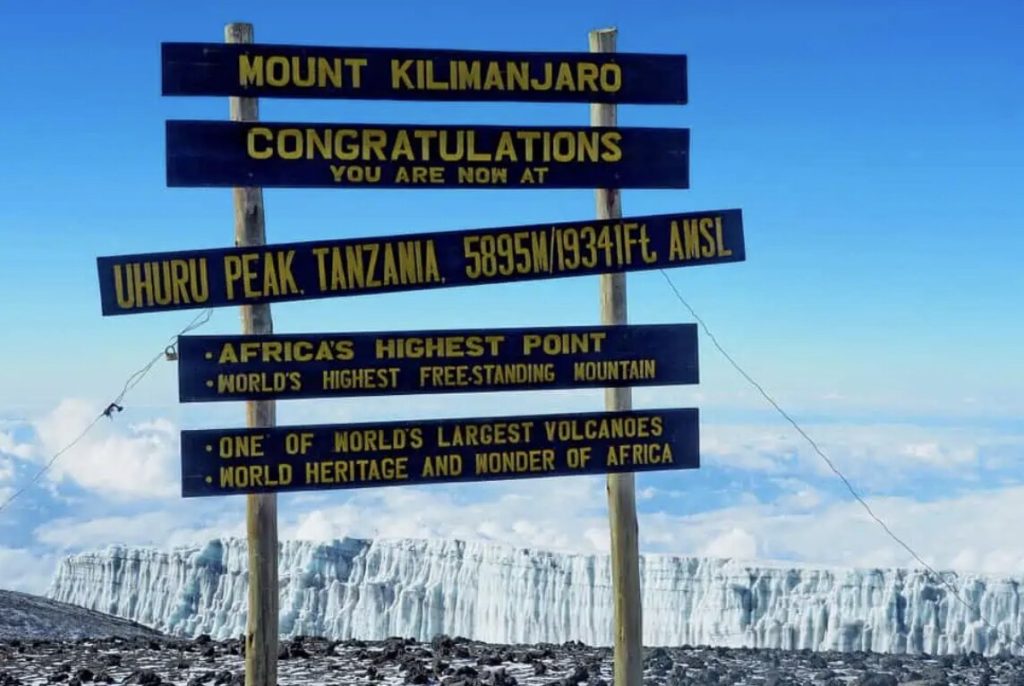
The summit is marked by a wooden sign, weathered and repeatedly replaced, carrying the elevation and a note that this is the highest point in Africa and the world’s tallest free standing mountain.
You will not be there long. Ten to twenty minutes is typical, and guides are firm about it for good reason: standing still at 5,895 metres in temperatures that can reach minus twenty degrees Celsius drains you fast, and the descent is long. Nobody lingers on this summit.
There is often a queue for photographs at the sign, particularly in July and August when several groups arrive within the same half hour. Have your camera accessible and your gloves manageable, because bare hands at that temperature stop working within a minute or two.
Temperatures at Uhuru sit below freezing all year, ranging from around minus four degrees Celsius in the middle of the day to minus twenty seven before dawn. Most trekkers arrive between six and nine in the morning, at the colder end of that range.
Many people describe feeling less than they expected at the top, which is worth knowing in advance. Exhaustion, thin air and the knowledge of the descent ahead flatten the moment for a lot of climbers, and the emotion often arrives later, at a lower camp or the gate.
A surprising number of trekkers say the crater rim moved them more than the summit sign did. By the time you reach Uhuru you are usually too tired to feel much, and the photographs do the remembering for you.
The Glaciers and Crater Views from Uhuru Peak
The ice is the reason many people describe this summit as worth seeing sooner rather than later.
The northern and southern ice fields sit on the crater rim, and the Furtwängler Glacier lies on the crater floor, named after the first man to ski down the mountain. From various points on the rim walk you can see the layered blue and white walls of these glaciers, which are considerably larger in person than photographs suggest.
They have retreated substantially over the past century and continue to do so. What remains is still dramatic, and standing beside a glacier three degrees from the equator is one of the genuine oddities of this mountain.
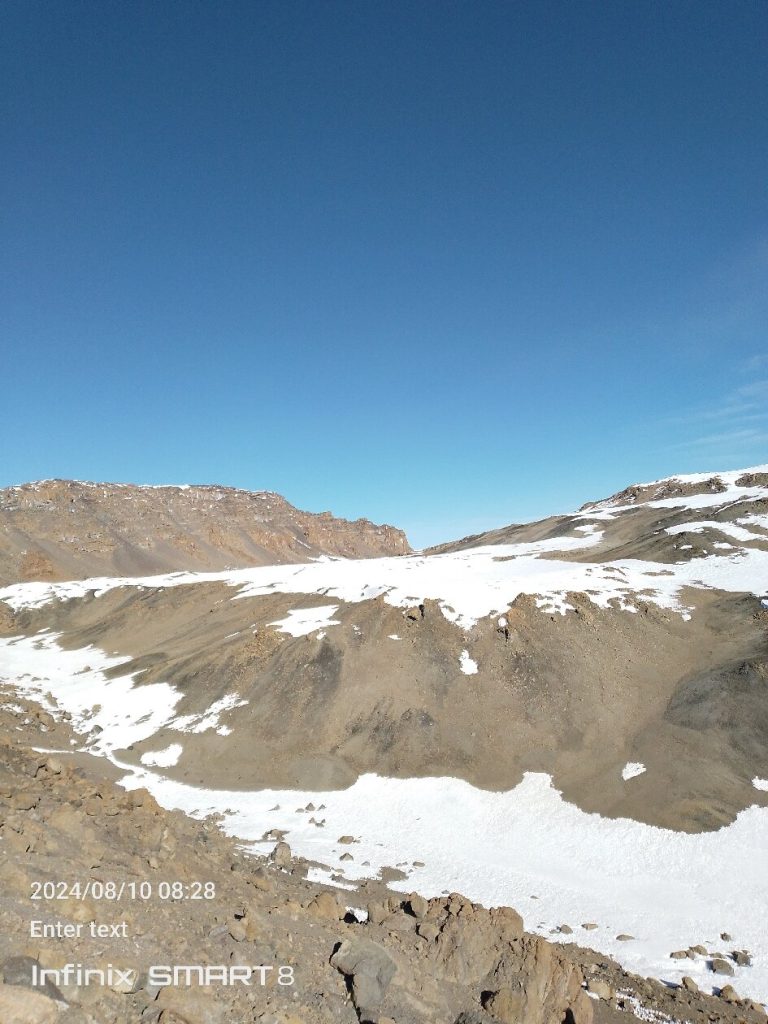
Inside the rim, the Reusch Crater holds an inner ash pit, evidence that this is a dormant rather than extinct volcano. Some long private itineraries include a night at Crater Camp at around 5,750 metres, which allows a walk to the ash pit and the Furtwängler Glacier. It carries an additional park charge and puts you at extreme altitude overnight, which is demanding and offers little acclimatisation benefit.
How Long a Climber Spends Above 5,000 Metres
Less time than most people imagine, and this is by design.
You cross 5,000 metres somewhere in the third or fourth hour of summit night, reach the rim between 5,685 and 5,750 metres after five to seven hours, walk one to two hours to Uhuru, spend ten to twenty minutes there, then descend. Total time above 5,000 metres is commonly four to six hours.
Nobody sleeps at the summit on a standard route, and the high camps at 4,670 to 4,750 metres are the highest you sleep. That is deliberate: the body does not acclimatise usefully above about 5,000 metres and simply deteriorates, which is why guides move groups down promptly and why Crater Camp remains a specialist option rather than a normal one.
The descent from Uhuru drops you nearly 2,800 metres in a single day, down to a camp around 3,100 metres on most routes. The improvement in how you feel is immediate and noticeable.
Uhuru Peak Climbing Odds by Route
Nine day Northern Circuit. Roughly 90 to 95 percent reach Uhuru Peak, the strongest figure on the mountain, though with the longer rim walk from Gilman’s Point.
Eight day Lemosho. Around 90 percent, arriving at Stella Point with the shorter finish to the summit.
Seven day Machame or Lemosho. Around 85 percent, also arriving at Stella Point.
Six day itineraries. Roughly 50 to 73 percent depending on trail and operator, with the shortfall almost entirely down to acclimatisation.
Five day Marangu. About 27 to 30 percent, and many of those who reach the rim stop at Gilman’s Point rather than continuing.
Overall. Estimates put the mountain wide figure at 65 to 80 percent, so roughly one climber in three does not stand at the summit sign.
Preparing Specifically for the Uhuru Peak Summit Push
Most of the preparation for this mountain is generic. A few things are specific to the last few hours.
Book a route that arrives at Stella Point if you have a choice and the eastern rim walk concerns you. Machame, Lemosho, Shira and Umbwe all do. That single hour of difference matters more at 5,700 metres than it reads on a page.
Have your camera and gloves sorted before you leave the high camp, because fumbling at the sign in that cold is miserable and sometimes means no photograph at all. Thin liner gloves worn under thick outer gloves are what make it possible at all. Keep spare batteries warm in an inside pocket, since cold flattens them quickly.
Set your expectation about time at the top. Ten to twenty minutes is what you get, and knowing that in advance prevents the disappointment of being hurried off a summit you spent a week reaching.
And prepare for the descent as seriously as the ascent. Trekking poles, a knee support if you have any history of knee trouble, and the understanding that half of the longest day of your trek happens after the summit.
Frequently Asked Questions About the Uhuru Peak Climb
How high is Uhuru Peak?
5,895 metres, or 19,341 feet, on the rim of the Kibo crater. It is the highest point in Africa, the highest walkable summit on the continent, and the top of the world’s tallest free standing mountain. Stella Point at roughly 5,750 metres and Gilman’s Point at about 5,685 metres are lower points on the same crater rim.
What does it cost to climb to Uhuru Peak?
Packages range from about $1,200 for a five day Marangu trek to $3,800 for the nine day Northern Circuit, with most well supported seven and eight day climbs at $2,000 to $3,500. Park charges account for a large share, at roughly $70 per person per day conservation fee plus $50 per night camping before the 18 percent VAT most tariffs exclude. A night at Crater Camp near the summit adds around $100 per person. Budget $250 to $450 for tips on top.
How long do you stay at the summit?
Ten to twenty minutes in most cases. Guides keep it short because standing still at 5,895 metres in temperatures that can reach minus twenty degrees Celsius exhausts climbers quickly and the descent to a lower camp takes several more hours. There may be a queue for photographs at the sign in July and August.
Is reaching Stella Point or Gilman’s Point the same as summiting?
No. Both are on the crater rim and both earn a park certificate, but Uhuru Peak is one to two hours further along the rim depending on which side you arrived from. Plenty of climbers stop at the rim, particularly on the eastern routes where the remaining walk is longer, and operators differ on whether they count rim arrivals in their published figures.
Can you see the glaciers from Uhuru Peak?
Yes. The northern and southern ice fields sit on the crater rim and the Furtwängler Glacier lies on the crater floor, all visible from points along the rim walk and from the summit itself on a clear morning. These glaciers have retreated substantially over the past century, which is why many climbers cite seeing them as a reason to go sooner. Views depend on cloud and cannot be guaranteed.
Do you need technical skills to reach Uhuru Peak?
Not on the standard trekking routes. There is no rope work, no crampons and no exposure, and the hardest scrambling anywhere on the mainstream trails is the hour on the Barranco Wall. The Western Breach passage to the summit is a genuine exception, being steep, exposed to rockfall and suited only to experienced mountaineers with a properly equipped operator.
Booking Your Kilimanjaro Trip
The safari companies and tour operators listed on this website put trips like this together for a living and know which camps, guides and routes actually deliver. We are an independent guide to Kilimanjaro; we do not book or sell tours ourselves.
When you are ready, arrange your safari, tour or holiday with one of the recognised operators listed here. Tell them your dates and what matters most, and a real person, not a form, will handle the itinerary, park bookings and logistics for you.